
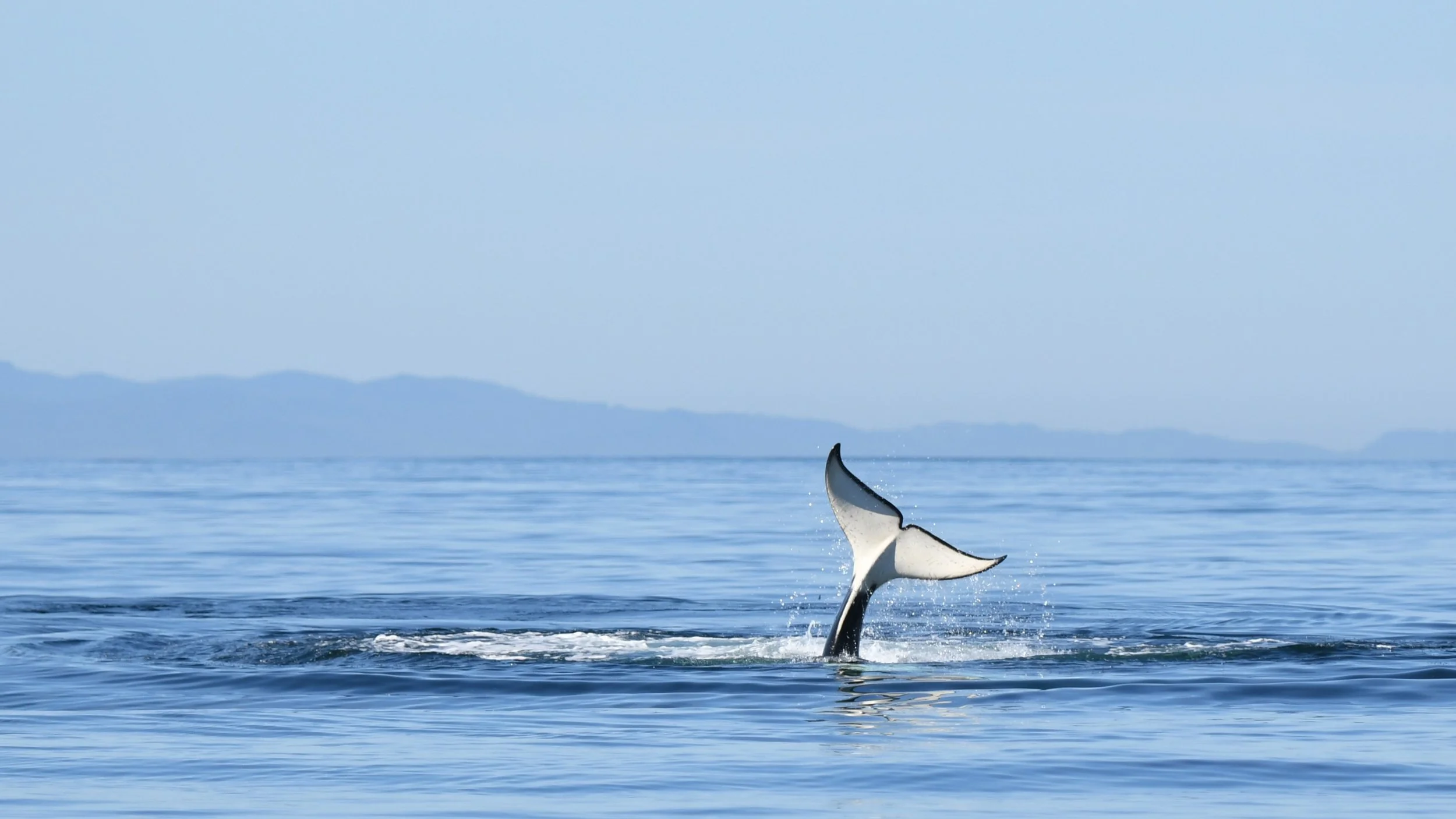
More Good News! Second New Baby Sighted in Jpod!

Photo courtesy of Leah Vanderwiel/Orca Spirit Adventures/Pacific Whale Watch Association.
All photos were taken with telephoto lenses and are cropped for detail.

Photos courtesy of Talia Goodyear/Orca Spirit Adventures/Pacific Whale Watch Association.
All photos were taken with telephoto lenses and are cropped for detail.
PWWA Naturalists Thrilled to Witness New Calf's First Breath
FRIDAY HARBOR, WA (September 25, 2020) – Following the recent news of the birth of a new baby in Jpod, and the subsequent report that J57 is a boy, comes even more good news from the Salish Sea.
Expectant mother J41, aka Eclipse, gave birth to her newest baby Thursday afternoon just miles off the Victoria, B.C. waterfront. This is J41's second calf. Her first calf, J51, is a male born in 2015.
The birth of the baby was witnessed by professional naturalists Talia Goodyear and Leah Vanderwiel, along with everyone aboard the Orca Spirit Adventures vessel Pacific Explorer. The crew and guests came upon the lone female killer whale as they were returning from viewing one of the dozens of humpback whales that are regularly seen in the region all summer, and were on their way to Race Rocks to finish their tour viewing seals and sea lions when they happened upon J41.
According to Goodyear, "We spotted who we soon identified to be J41 just southwest of Race Rocks. She appeared to be alone at the time and stayed very close to the surface for a few minutes. After going under for several minutes, she reappeared, and this time it looked like she was pushing something with her rostrum. She surfaced like this 3 or 4 times."
"It took us a little while to really figure out what was going on," said Goodyear, "so it was a bit of an emotional roller coaster as we thought of all the possibilities. Although we thought we were certain this was an SRKW, we did question whether this was a Biggs killer whale with a seal, or if we were seeing a buoy and this was an entanglement, and then we were concerned we could be re-living the tragic situation with J35 and her deceased calf from 2018."
"She was aiding the baby up for a few breaths with her rostrum," added Vanderwiel, "at which point the little one started surfacing on its own. It appeared to be a rambunctious little bundle of baby, as every surface was exaggerated and playful. We watched as they continued to head off southwest from Race Rocks."
"It was an emotional time as we processed what was happening in front of us," said Vanderwiel. "It took a few minutes to realize what was actually happening, but then it was pure excitement realizing that it was a birth and the baby was very alive and boisterous."
While the majority of PWWA whale watching tours are focused on the thriving Biggs mammal-eating killer whales, abundant Humpback whales and other marine wildlife, occasional chance encounters with the world-famous Southern Resident Killer whales (SRKW) do occur. During these brief encounters naturalists educate their guests about the SRKW, their matrilineal social structures, their playful nature and life histories, and explain to their guests the challenges the beloved endangered SRKW population currently face for their very survival.
Following their brief encounter, and while the excitement was still coursing through their veins, Goodyear and Vanderweil alerted the PWWA and the Center for Whale Research about their observation, and provided their photos for analysis once they returned to shore.
While the trained professional naturalists were certain that the new mother was J41, and believe that they witnessed the calf's first breaths, their photographs were sent to whale researchers to confirm their identities and to hopefully determine their body condition based on the photos provided.
According to Ken Balcomb, founder and executive director of the Center for Whale Research, the photos of the mother are confirmed to be those of J41 and a brand new baby. "We're very pleased to see that J41 has had her baby," said Balcomb, "however, it's too soon to determine the status of the calf, and further observations are necessary before we'll make an announcement of the new baby's health."
As the PWWA remains cautiously optimistic for the health and survival of yet another beautiful new addition to Jpod, survival for the endangered SRKW population directly correlates with the health of Chinook salmon.
Dramatic declines over the past several decades of Chinook salmon throughout their critical habitat continues to be the biggest threat to SRKW recovery. Salmon stocks that the SRKW rely upon throughout the year primarily include Chinook salmon that spawn in the Fraser River, Columbia River, and Sacramento River systems.
In contrast, Biggs mammal-eating killer whales have produced over 80 new calves in the past ten years in the shared waters of the Salish Sea due to abundant marine mammal prey resources and are thriving throughout the region.
####
PHOTO CREDIT MANDATORY:
Photos courtesy of Talia Goodyear/Orca Spirit Adventures/Pacific Whale Watch Association and Leah Vanderwiel/Orca Spirit Adventures/Pacific Whale Watch Association. All photos were taken with telephoto lenses and are cropped for detail.
PWWA Cautiously Optimistic for New Jpod Baby

Prolonged Absence, Lack of Critical Prey Remain Key Concerns
FRIDAY HARBOR, WA (September 6, 2020) – The Pacific Whale Watch Association and every one of our professional members are thrilled by the addition of a new baby orca in Jpod. We are proud and pleased to have been the first to spot the new addition, playing a significant role in alerting researchers to the calf’s presence and coordinating efforts to locate and identify the new baby.
"As we were watching the greeting ceremony between J and L pods unfold Saturday, it felt like a special day on the water,” said Sarah McCullagh, a professionally trained captain and naturalist for San Juan Safaris of Friday Harbor. “We first saw J35 and her son J47 off by themselves away from the main group, then as we watched we quickly realized that there was a very small fin tucked in next to them. We called the Center for Whale Research over to investigate and sure enough they confirmed that J35 had a new calf J57. I was obviously elated, so excited for J35 after the incredible loss she suffered a couple of years ago, but also for the Southern Resident community as a whole. I definitely cried."
Researchers from the Center for Whale Research confirm the new Jpod was born to 22-year-old mother J35, Tahlequah, who two years ago made international news when she carried her dead calf for 17 days throughout the Salish Sea, highlighting the plight of the Southern Resident Killer whales (SRKW) and the devastating lack of Chinook salmon, critical to their survival.
The PWWA community plays a vital role as ‘Sentinels of the Sea,’ providing real-time sighting and reports of whales to researchers, enforcement agencies, the maritime shipping industry, military vessels, ferries, and private boaters alike.
While the PWWA is committed to providing our expertise for the protection and public education of whales, we remain concerned that the SRKW are spending little to no time in what was once a significant traditional and historical summer fishing grounds here in the Salish Sea.
We are relieved to hear from research colleagues on the outer coast of Vancouver Island that the SRKW have been finding critical food sources off Swiftsure bank and Chinook salmon habitats to the north. Researchers are reporting that the whales are generally looking robust and healthy, finding food in areas outside the Salish Sea.
As we remain cautiously optimistic for the health and survival of this beautiful new addition to Jpod, we hope this news does not distract or detract from the real issues and threats these whales face in this region.
Although there have been significant increases in Humpback and Biggs mammal-eating killer whales in the Salish Sea in recent years due to prey abundance, this year there were no SRKW reported in their summer fishing waters during the entire month of May, June, and August. These are months that in the past were once filled with the presence of boisterous, happy, well-fed salmon-eating whales consuming Chinook salmon, now critically endangered themselves.
Chinook salmon stocks in this region, and especially in the Fraser River watershed, are crashing due to decades of commercial scale overfishing and dramatic reductions in critical salmon habitat throughout the region due to increasing human populations. Unless something is done to return Chinook salmon populations to their historic numbers we fear the continued absence of SRKW in the Salish Sea will continue.
With the new addition to Jpod, the PWWA remains unified with our partners at NOAA, Washington Department of Fish & Wildlife, Transport Canada, Department of Fisheries and Oceans Canada, and the research community in asking vessels to please keep their distance from the new calf and the critically endangered SRKW.
The PWWA has for over the past quarter-century developed and maintained world-class standards for whale-watching best practices, including: slowing to under seven knots at a half-mile from all whales; not crossing or stopping in the paths of whales; remaining at legally defined safe distances from whales; limiting vessel numbers when in the presence of whales; reducing viewing times with whales; and alerting private vessels —which account for nearly 90% of all whale harassment incidents—to the presence of whales.
The PWWA remains committed to the protection and restoration of Southern Resident Killer whales and the conservation and restoration of Chinook salmon populations they need to survive.
We ask the public to join us in our efforts to protect the whales and wildlife we all care so deeply about.